01
Keep the plant safe
Regulation 35 requires workplace gas appliances, pipework and flues to be maintained in a safe condition to prevent risk of injury. This covers the commercial gas system, not only the boiler casing.
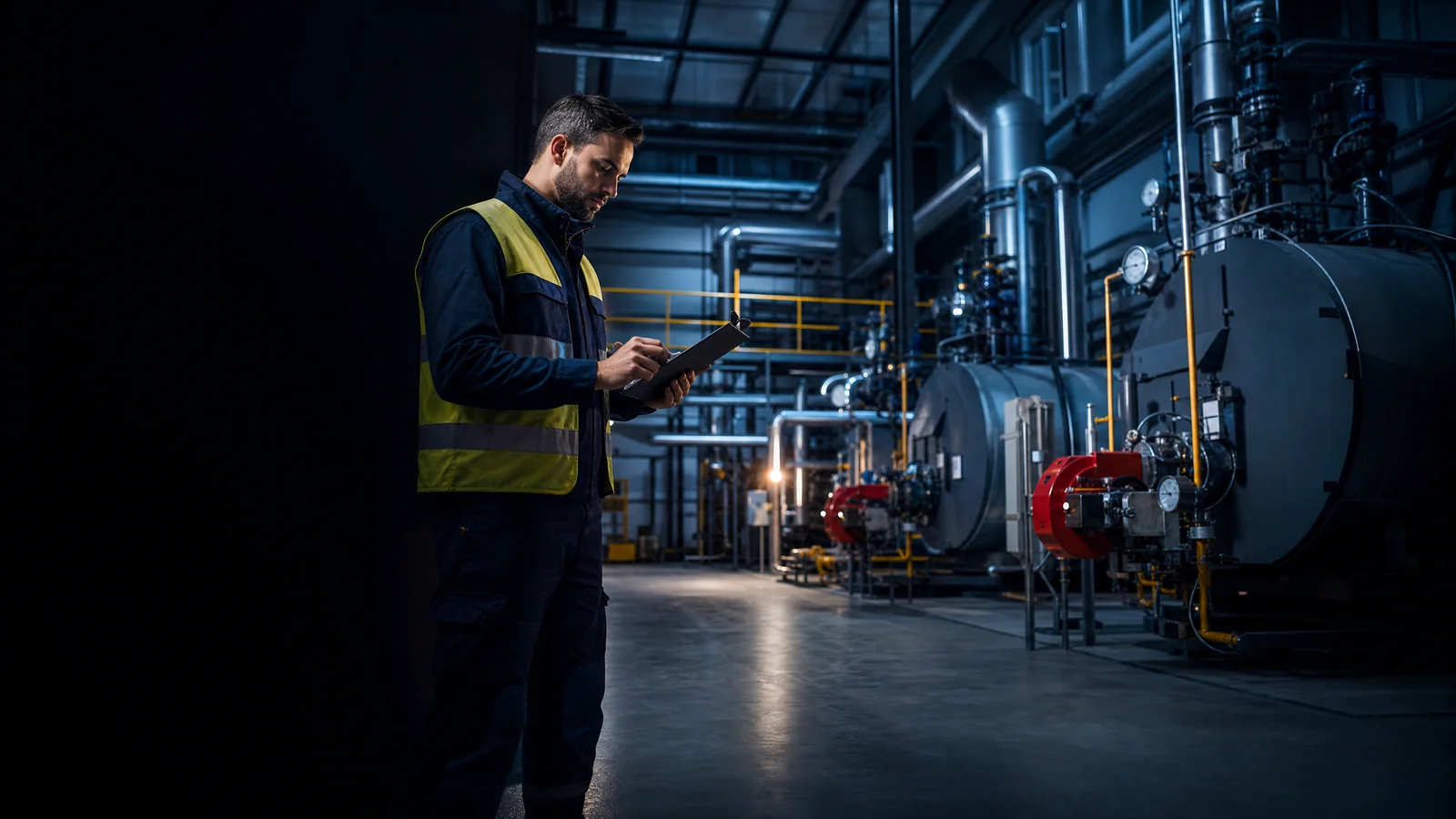
Derby commercial sites · repair service
Need commercial boiler repair in Derby? We repair commercial boiler systems for businesses. Call 07836 720624 or send your site and fault details so the repair process can move forward.
Gas Safe legal requirements
For a workplace, the employer or self-employed person responsible for the site has a legal duty to keep gas appliances, installation pipework and flues under their control maintained in a safe condition. In Great Britain this is Regulation 35 of the Gas Safety (Installation and Use) Regulations 1998; Northern Ireland has the same workplace maintenance duty under its 2004 Regulations. Gas work must be completed by a Gas Safe registered engineer who is qualified for the work.
Regulation 35 requires workplace gas appliances, pipework and flues to be maintained in a safe condition to prevent risk of injury. This covers the commercial gas system, not only the boiler casing.
For workplaces such as shops, restaurants, schools and hospitals, HSE says work on gas fittings must be carried out by a Gas Safe registered engineer who is qualified for the work.
We recommend a planned annual service and safety review every 12 months, alongside manufacturer instructions and site risk management. The law requires safe maintenance; it does not set one universal 12-month check for every commercial boiler.
Direct answer
Commercial boiler systems can involve larger heat exchangers, circulation pumps, combustion fans, controls, pressurisation equipment, flues and multiple boilers operating together. A fault display is useful, but the repair plan also needs the wider plant-room and operating context.
Describe the lockout, loss of heat or hot water, pressure concern, leak, alarm, unusual sound or control behaviour. Include when it began and whether the system remains in use.
Boiler make, model, fault code, number of boilers, known controls and site postcode all help move a commercial repair request forward.
Let us know about occupied areas, critical heat or hot-water loads, permits, delivery routes, plant-room access and any operating restrictions.
Technical commercial repair context
Every installation is different. The points below help you give us the right information about the system and the building, so the repair conversation can get specific quickly.
On a commercial system, engineers should distinguish primary and secondary circuits, check differential temperatures and flow, and consider whether dirt, scaling, air or inadequate hydraulic separation is restricting heat transfer—
Treat the checks a facilities team can prepare for, including pump duty and rotation, system pressure/expansion-vessel condition, low-water protection, lead-lag rotation and whether sequencing matches the building's changing load;
Keep a record of the relevance of safe combustion-air and flue routes, fan proving, burner interlocks, sensors, setpoints, alarm history and BMS enable/disable signals, especially where access may be controlled or plant is distributed across an operational site.
Before work is planned, have the plant-room location, induction or permit rules, isolation points, roof or confined access, lifting route, boiler layout, critical loads and available alarm data ready. This gives the repair discussion the proper site context.
Derby operational context
Derby City Council's economic assessment states that the city economy has traditionally been based on manufacturing and engineering, and reports that manufacturing accounted for 22% of employment in 2009, compared with a 16% regional average; it also identifies large employers including Rolls-Royce and Bombardier. The Council's separate Planes, Trains and Automobiles research describes Derby's strong industrial base across aerospace, automotive and rail, and records that the aerospace sector directly employed approximately 10,338 people in Derby in 2007 (the report's dated estimate). For a facilities manager, this is useful context—not a claim about any particular premises: some Derby sites may involve process-sensitive production, large or distributed heat loads, controlled access and a higher need to plan around operational continuity. Any access, redundancy or critical-load assumption must be confirmed site by site.
From fault details to the next repair step
We repair commercial boiler systems for businesses. The clearer the site and fault information, the faster the repair discussion can become specific to the plant and building.
Tell us what the system is doing, what is affected and any code or plant information you have.
Include postcode, access notes, number of boilers, key operating loads and the contact managing the site.
We will use the information to move the commercial repair requirement into the appropriate next step.
Where plant access, controls or continuity matters, keep the responsible facilities contact involved as the repair requirement progresses.
Related repair information
Use the national repair page for broader commercial boiler repair guidance or browse repair pages by city. Ongoing cover, planned maintenance and a current repair are separate business decisions.
Last reviewed: 19 October 2026
Questions
Yes. We repair commercial boiler systems for businesses in Derby. Call 07836 720624 or send the site and fault details so the repair requirement can move forward.
Include the site postcode, contact details, boiler make and model if known, any displayed fault code, what has been observed, when it began, the boilers affected and any access or operating constraints.
Commercial systems can include larger heat exchangers, circulation pumps, combustion fans, controls, pressurisation equipment, multiple boilers and hydraulic interfaces. The wider system may need to be considered before repair work is scoped.
Yes. A current repair requirement, planned maintenance and future cover are separate business decisions. Send the site and fault details so the repair requirement can be considered clearly.
It can depend on the plant design, sequencing controls, hydraulic arrangement and the critical loads served. Tell us how many boilers you have, what remains operational and any alarm or control information.
Larger plant rooms can involve heat exchangers, pumps, combustion fans, flues, controls, pressurisation equipment, access restrictions and safe isolation planning. Clear site information helps us focus on the actual system.
Commercial repair enquiry
Send the fault details, plant information and site access notes. We repair commercial boiler systems for businesses and will contact you about the repair next step.